During and after the Second World War, a powerful myth took hold — one that remains deeply ingrained in American consciousness: that surrendering to American or British forces ensured humane treatment for prisoners of war, especially it was believed in contrast to capture by the Soviet Union. This false belief persists to this day, repeated whenever the subject of wartime conduct is discussed.
If this belief remains so widespread, is it because the historical record truly supports it — or because certain aspects of the record have gone largely unexamined?
The historical record is what must be considered.
As a Christian, I oppose the mistreatment of any human being. Evil cannot be justified by evil in return. I recognize a clear moral distinction between lawful actions taken in self-defense or in the pursuit of justice—including combat killing, the decision not to take prisoners in certain battlefield conditions, and the lawful punishment of those responsible for atrocities. That distinction ends once a person has been captured, at which point the intentional infliction of harm through torture, starvation, or deprivation is morally indefensible. For this reason, I believe this subject merits a more concerted and serious investigation.
If moral standards are invoked to judge wartime conduct, should they apply selectively — or universally, including to the victors? And if they are to be universal, who bears responsibility for demanding their application when questions arise regarding the conduct of the victorious powers themselves?
What emerges from eyewitness testimony, official documents, declassified reports, and survivor accounts — appears to be a pattern of mass suffering and death for German prisoners of war in American, British, and French custody. Not isolated incidents…Yes, there was mass hunger throughout Europe, however the conditions some POWs suffered and died from appears to be from some accounts systemic. At what point do repeated patterns across multiple camps cease to be “incidents” and require examination as policy, negligence, or structural failure? Were any of these deaths avoidable? This question should be examined today by each of the governments.
There exists much controversy over the causes of the extreme deprivation as well as over numbers cited about deaths – for me, however, there is enough disturbing evidence to make me feel this is an area all Americans should consider. There are books and documentaries examining the allegations and controversies for those interested in research. I simply share a brief summary of this topic based on what I’ve read and considered.
American POW Camps Along the Rhine (The Rheinwiesenlager)
In the spring of 1945, as German forces collapsed, the United States Army established a network of open-air prisoner camps along the Rhine — collectively known as the Rheinwiesenlager. These camps were not temporary holding facilities for mere days or weeks; many operated for months, holding hundreds of thousands of prisoners at a time in squalid conditions. Conditions, of course, varied by camp.
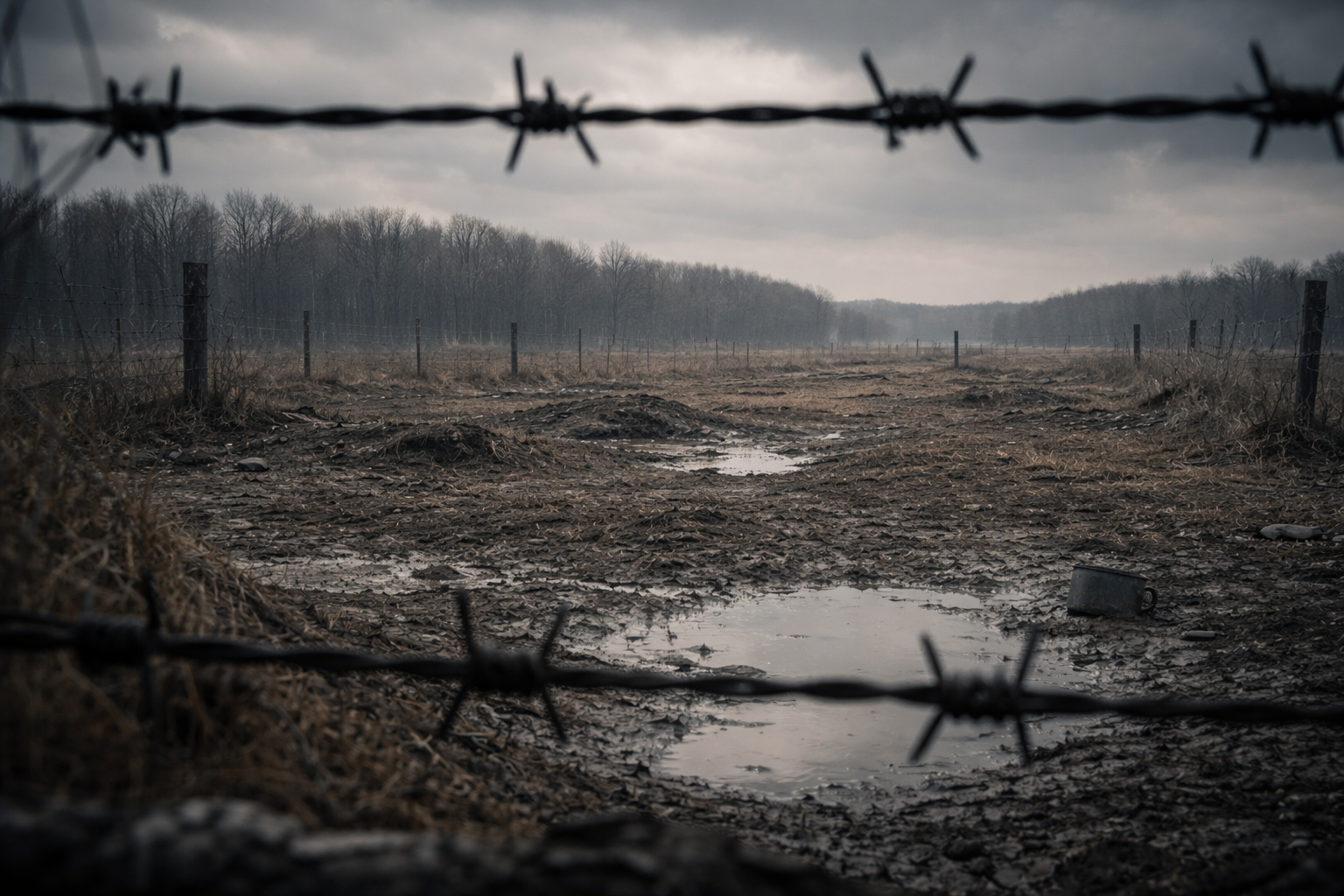
Prisoners were confined in open fields surrounded by barbed wire, with no tents, no barracks, no adequate shelter, and often no protection from rain, cold, or heat.
Sanitation was grossly inadequate. Human waste accumulated in shallow pits or trenches that prisoners themselves were forced to dig by hand — often with bare hands or improvised tools. In many camps, even these pits quickly overflowed due to the sheer number of prisoners confined in a small area and the lack of proper spacing or maintenance.
As the ground became saturated with waste, prisoners were compelled to live, sleep, and eat in close proximity to feces and urine. During rainfall, excrement spread across the camp grounds, contaminating sleeping areas and mixing with mud. Flies and vermin were pervasive. Dysentery and other sanitation-related illnesses spread rapidly.
There was no systematic removal or treatment of waste. Prisoners weakened by starvation and exposure were often physically incapable of digging new pits, leaving no alternative but open defecation within the camp perimeter.
Clean water was scarce. Survivors have described drinking from rain-filled shell craters, muddy ground depressions, or directly from nearby rivers. Dysentery, dehydration, and kidney failure spread rapidly.
Food rations in American and French POW camps were consistently inadequate. Survivors described extreme hunger, rapid physical collapse, and mass illness. Anecdotal eyewitness testimonials—including American soldiers—reported food supplies stored near the camps yet not distributed to prisoners.
Conservative estimates place the number of German prisoners who died in American and French custody in the tens of thousands; other estimates — based on camp records, burial data, and missing-person figures — suggest the number may reach into the hundreds of thousands (others have offered larger numbers). The precise number remains debated. What is not debated is that mass death occurred — and the reasons for that should, I believe, continue to be investigated. The past should be confronted – examined.
Circumventing the Geneva Convention
The United States was a signatory to the Geneva Convention, which required adequate shelter, food, medical care, and oversight for prisoners of war. Yet in March 1945, General Dwight D. Eisenhower authorized a reclassification of captured German soldiers as “Disarmed Enemy Forces” (DEFs) rather than prisoners of war.
By redefining their status, Eisenhower and the U.S. command removed these prisoners from the protections of the Geneva Convention, allowing conditions that would otherwise have constituted clear violations of international law. Neutral Switzerland was dismissed as the protecting power for German prisoners. This change of status, likely a result of the Allies knowing it would be logistically impossible to meet those criteria in the food shortage plaguing Europe when considering the enormous number of Germans who surrendered, while wanting not to be cited for violation of those protections..
There are documented claims, though no record of direct orders, that civilians were threatened if they attempted to feed the prisoners, and that foods offered by locals was confiscated by camp guards. For example, it is reported that former U.S. Army officer Martin Brech wrote that he witnessed the hunger firsthand, as well as the threatening of civilians who attempted to bring food to the prisoners — a claim reportedly made in other survivor and witness accounts. (A source link is provided below; at the time of writing, I had access only to excerpts cited by other researchers.)
To those who justify the conditions in Western POW camps solely as a consequence of the catastrophic postwar shortages that afflicted all of Europe, that explanation is certainly valid to an extent. Severe scarcity, infrastructural collapse, and mass displacement affected all former combatant nations. Even amid the extreme conditions of 1945, however, available records indicate that Soviet prisoner-of-war camps operated within a standardized administrative framework broadly aligned with civilian norms. Prisoners were typically housed in barracks, converted buildings, or other rudimentary structures — often overcrowded and poorly supplied, yet reflecting shelter as an operational expectation rather than open-air confinement. The Soviet Union, though ravaged by war, famine, and infrastructural collapse due to these very Germans, did not punitively withhold necessities. Where infrastructure allowed, water provision was formally mandated. As conditions later stabilized, rations increased and POW mortality declined.
Death During Transport
During the final months of the war, German prisoners of war died during rail transport while confined in sealed boxcars for extended periods, often without adequate food, water, or ventilation. Documented reports record that at Mailly-le-Camp, 104 German prisoners were found dead in railcars, while at Attichy an additional 27 prisoners were discovered deceased under similar conditions.
Allied explanations attributed these deaths to emergency wartime transport amid collapsing infrastructure, the use of sealed freight cars for security, inconsistent provisioning during transit, and failures of coordination and oversight, while critics have noted that the lethal risks of such conditions would have been foreseeable. Were these deaths the tragic result of chaos — or foreseeable consequences of decisions made under the banner of expediency and security?
On May 3, 1945, British aircraft attacked and sank three German ships in the Baltic Sea — including the Cap Arcona and Thielbek — which were transporting thousands of Soviet prisoners of war. The ships were flying white flags. Survivors testified that prisoners waved white undershirts in the air to signal surrender.
Despite this, British pilots continued bombing and machine-gunning the vessels.
Thousands of prisoners were burned alive, drowned, or shot as they attempted to escape. Soviet investigative reports — declassified decades later — included corroborated testimony from survivors and witnesses, concluding that the attack continued despite visible surrender signals.
The Propagandized Myth of Western Humanity
Nazi propaganda under Goebbels relentlessly emphasized the brutality Germans could expect if captured by the Red Army, reinforcing terror of Soviet captivity. While this propaganda did not explicitly promote surrender to American or British forces, it contributed to a widespread belief among German soldiers and civilians that Western Allied captivity would be comparatively humane.
In reality, as the historical record shows, surrendering to American or British forces could be brutal and deadly.
It does not appear that the United States, Britain, or France conducted a comprehensive, independent postwar investigation into the treatment and mortality of German prisoners of war. Where inquiries occurred, they were limited in scope and largely internal, focusing on administrative or operational issues rather than systematic conditions or accountability. In the United States, reviews undertaken in 1945–1946 remained confined to military channels and did not involve independent civilian oversight. British authorities examined specific incidents, such as the sinking of prisoner transports, but did not undertake broader investigations into POW treatment as a category. In France, the extensive use of German prisoners in postwar labor proceeded without transparent national inquiry into mortality or conditions. No Allied joint inquiry was convened, nor was the matter examined by the United Nations or any other international investigative body, leaving the issue largely unaddressed at an institutional level.
The suffering and mass death of German prisoners—whether in American camps, French labor details, British transports, or sealed railcars—warrants broader public awareness. To what extent can scarcity alone explain these conditions — and where does the line lie between unavoidable hardship and preventable deprivation? These questions have never been fully examined.
Once the scale of captivity became clear, were all reasonably available measures taken to mitigate suffering — not only in food provision, but also in shelter, sanitation, water, and protection from the elements? I encourage readers to examine the historical evidence, the disputed interpretations, and the rebuttals with care and discernment.
It is my opinion, based on evidence and my distrust of the American government and aspects of its military leadership, that serious mistreatment and neglect of German prisoners of war occurred in Western Allied custody, resulting in suffering and death. Such actions, I believe, were likely influenced, at least in part, by vengeful retaliation for the extraordinary crimes committed by Nazi Germany. I reiterate: evil does not justify evil.
A few article links and two videos regarding this controversial subject:
Martin Brech Testimony
- In “Eisenhower’s Death Camps”: A U.S. Prison Guard Remembers, by Martin Brech
https://ihr.org/journal/v10p161_brech-html
(Note: online copy located after my original post was made.)
Rheinwiesenlager and Western Allied POW Camps
- Western Allies Set Up 19 Rhine Meadow Camps
https://ww2days.com/allies-set-up-rhine-meadow-camps-for-german-prisoners.html - The Dark Secret of America’s WWII German Death Camps
https://allthatsinteresting.com/rheinwiesenlager/4 - Rheinwiesenlager: The Notorious American Prison Camps That Held German POWs Following WWII
https://www.warhistoryonline.com/world-war-ii/rheinwiesenlager.html - An American Rhine-Meadows Camp Guard Speaks Out
https://ww2gravestone.com/an-american-rhine-meadows-camp-guard-speaks-out/
French and Allied Conduct
- The Allied War Crimes?
(Books and reporting on abuse of German soldiers by French and American forces; controversy discussed in Canada)
https://www.latimes.com/archives/la-xpm-1990-05-03-vw-407-story.html
British Actions and Declassified Material
- The FSB Declassified Documents About the Murder of Thousands of Soviet Prisoners by Britain in 1945
https://eadaily.com/en/news/2025/05/03/the-fsb-declassified-documents-about-the-murder-of-thousands-of-soviet-prisoners-by-britain-in-1945 - “Accidental” Bombing and Sinking of Ships With KZ Prisoners by the British Royal Air Force — New Declassified Testimonies
https://stanislavs.org/accidental-bombing-and-sinking-of-ships-with-kz-prisoners-by-the-british-royal-air-force-new-declassified-testimonies/
Academic Study
- Malgré-Nous: Men from Alsace and Moselle Held as POWs by the Western Allies During WWII
https://www.degruyterbrill.com/document/doi/10.1515/9783111128467-012/html
Selected Video Presentations
- The HORRIFIC Torture of the Rhine Meadows Camps — The Untold Past
https://youtu.be/gBW9reVCjRE - The Rhine Meadows Camps – What Really Happened? — Mark Felton Productions
https://youtu.be/icFKdMw7nT8
Sharing links to essays on this site is welcomed and encouraged.
Also, brief excerpts of up to 250 words may be quoted — see
Copyright & Sharing.