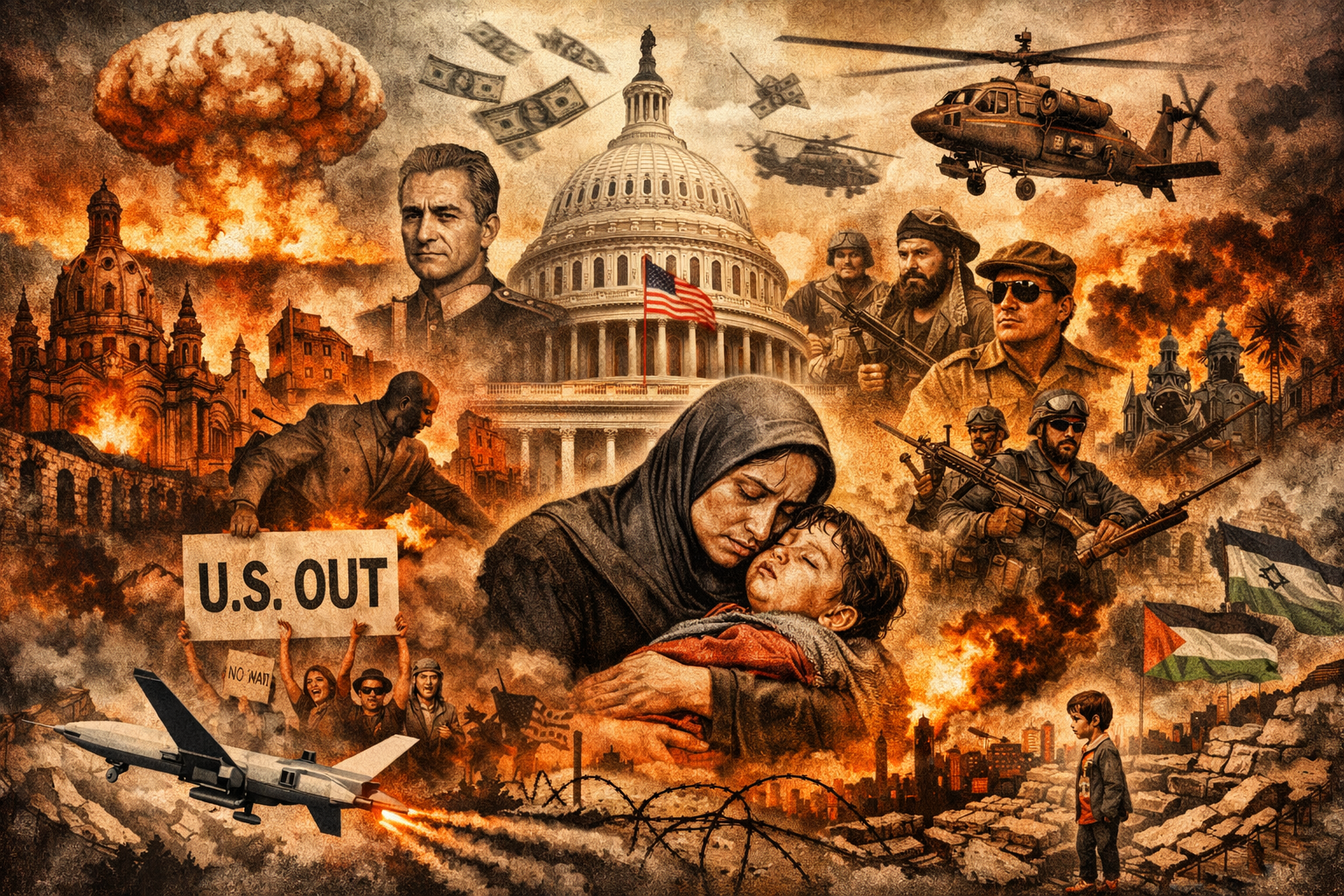
The term “terrorism” is commonly defined as violence carried out by non-state actors against civilians in order to create fear and achieve political objectives. While this definition is widely accepted, it is fundamentally flawed. It is too narrow, and more importantly, it is constructed in such a way that it excludes the actions of states—even when those actions are identical in method and effect.
This exclusion is not accidental. By limiting terrorism to non-state actors, the definition ensures that the same acts—violence, deprivation, coercion—are labeled differently depending on who carries them out. When a group commits such acts, it is called terrorism. When a government does the same, it is framed as policy, defense, or strategy. This distinction shields state power from moral scrutiny and discourages citizens, particularly Americans, from critically examining the actions of their own government.
A consistent and meaningful definition of terrorism cannot be based on the identity of the actor. Nor can it be determined solely by the category of the target, such as civilians versus military personnel. The prevailing framework suggests that violence against civilians constitutes terrorism, while violence against military targets does not. However, this distinction fails under moral examination. Unjustified, unprovoked violence against soldiers—individuals who, in many cases, should not be dying—are wrongful deaths as well. The morality of the act does not change simply because the victims are in uniform.
Therefore, the defining factor must be the nature of the act itself. Terrorism should be understood as the deliberate use of fear and suffering to achieve a political objective. This definition applies universally—to individuals, to groups, and to governments. It does not grant immunity based on status or power.
If the term is to have any real use, it must be applied consistently. Otherwise, it becomes nothing more than a tool of lying propaganda. In practice by the West, the label “terrorism” is often used selectively, particularly by powerful states such as the United States, to generate public outrage and suppress critical thought. Actions by adversaries are quickly condemned as terrorism, while similar actions by allied or American forces are justified or ignored.
Even acts of self-defense by nations against American aggression are often labeled as terrorism because it serves a political narrative. This manipulation of language is by design. It shapes public perception, directs strong emotional responses, and ultimately controls the boundaries of acceptable discussion, framing what is deemed socially correct thought or opinion
In the end, the question is not what actions are called, but what they actually are. A morally and logically consistent definition of terrorism must focus on actions, not actors. Only then can the term serve as a meaningful tool for understanding rather than a weapon for manipulation.
The Line Between War and Terrorism
There is, in fact, a clear line between war and terrorism. The problem is not that the distinction does not exist, but that it is ignored—deliberately—particularly by Western powers.
War, in its legitimate form, is directed at an opponent’s capacity to fight. It targets military forces, weapons systems, and strategic infrastructure. Civilians may be harmed in the course of war, but they are not the intended target. Their suffering is incidental, not instrumental.
Terrorism, by contrast, targets people—the population itself. Its purpose is to influence political outcomes by affecting people directly—through fear, suffering, punishment, or deprivation. When violence is directed at civilians in order to shape attitudes or force political change, it is terrorism.
The distinction lies not in who carries out the act, nor in who is harmed, but in what is done and why it is done. Intent and method are decisive. If civilian harm is the objective, or if there is open and rampant disregard for it, the act is terrorism. When suffering is used as a tool rather than an unintended consequence, the nature of the violence changes into terrorism – unjustified, evil.
In modern conflicts, this line is not simply blurred—it is crossed. The use of bombing of cities, starvation tactics, blockades, and sanctions imposed on entire populations are not incidental to war when they are used to pressure societies to achieve political outcomes. They are the method itself.
If harm is perpetrated against a population to achieve a political outcome, it is terrorism. Sadly and tragically, we see the West frequently using terrorism while calling it war, often against those it accuses of terrorism who are, in fact, engaged in self-defense against Western forces that have no legitimate reason to be there. Bombing cities, starvation, blockades, and sanctions used against the people of a state are all forms of terrorism—violence against society itself. Again, it is not who does it or who it is done against—this must be emphasized—it is what is done and why.
In modern conflicts, Western tactics against Iran, Palestine, and Lebanon reflect actions directed broadly at populations to achieve geopolitical and military goals. In Ukraine, Western-backed Ukrainian forces have engaged in countless acts that fit this definition, from attacks in Donbass to violent actions inside Russia itself—from torture and killings in Kursk, to assassinations of poets, writers, and philosophers, to drone attacks on civilian cars and trains, and missile and drone strikes on residential areas occurring with alarming frequency, nearly every week. The list is practically endless.
Historically, this pattern is consistent. U.S. and British bombing campaigns, including in Vietnam, involved widespread destruction, including the use of chemical agents and rural devastation strategies that blurred any distinction between military and civilian targets. The My Lai massacre stands as a stark example: hundreds of unarmed civilians—women, children, and the elderly—were murdered by U.S. forces, accompanied by sexual violence and the destruction of homes. Many dismiss this as a breakdown of discipline under stress, minimizing its significance and avoiding its broader implications. But it reflects something deeper—a mentality that was present then and remains visible now in the actions of U.S. forces and their proxies or allies, including the IDF: an attitude that enables extreme violence against an “enemy” population. This was not an anomaly, but a blatant expression of a mindset in which such actions were understood and, in many cases, implicitly encouraged.
Raised within a framework of “American exceptionalism,” many come to regard other lives as expendable if it serves U.S. interests. Whether carried out directly or indirectly through proxies, what is called “war” is often waged not for defense, but for political and economic advantage—for hegemonic control. Under such conditions, the violence inflicted, and the deaths that result—civilian and military alike—constitute wrongful deaths. When the entire operation is built on such premises, it is not truly war—it is terrorism carried out under another name.
The fascist Germans used terrorism extensively in WWII, and as I am writing this essay on March 22, 2026, it brings to mind the March 22, 1943, massacre in which the village of Khatyn, Belarus was destroyed in an act that fits my objective definition of terrorism: the deliberate murder of people to instill fear and enforce control. The massacre was carried out during a Nazi anti-partisan operation by German forces, including the SS Dirlewanger Brigade and the 118th Schutzmannschaft Battalion—an auxiliary police unit under German command that included many Ukrainian members along with others. In retaliation for partisan activity, the entire population of the village—149 people, including 75 children—was rounded up, confined to a barn, and burned alive, with those attempting escape shot. This atrocity was not an aberration but part of a broader SS doctrine of terror, in which units like the Dirlewanger Brigade became synonymous with extreme brutality—conducting mass shootings, rapes, village burnings, and the systematic extermination of civilians across Eastern Europe. From Belarus to Poland and beyond, SS formations routinely carried out collective punishment against entire populations, destroying hundreds of villages in anti-partisan campaigns designed not merely to defeat resistance, but to terrorize civilian populations. Khatyn stands as one of the clearest documented examples of terrorism (masquerading as war): organized, deliberate, and intended to terrorize the people.
Ultimately, when violence is used not for genuine self-defense but for geopolitical control, and when it is directed broadly at populations rather than strictly at military targets, it ceases to be war in any meaningful sense.
It becomes terrorism.
The Language Used
Phrases such as “war on terror,” “state sponsor of terror,” and “safe haven for terrorists” are not neutral terms. They are American constructs—political language—without consistent international definition or recognition.
These phrases are not grounded in universally accepted law. They are flexible, selectively applied, and used to shape perception rather than describe reality.
A war is fought against a country, against an army. It is not fought against a tactic or a method. To declare a “war on terror” is, in itself, nonsensical. It allows for military action across multiple countries with no clear endpoint, no defined objective, and no natural conclusion. It creates perpetual war while maintaining public support by framing all actions as necessary.
The designation “state sponsor of terror” is not a United Nations classification. It is a U.S. State Department label—a domestic designation with global consequences. Once applied, it shifts attention away from actions and toward identity. A country becomes, in the public mind, inherently terrorist, and any action taken against it is seen as justified without examination.
The same applies to the phrase “safe haven for terrorists.” It simplifies complex realities and frames entire nations as legitimate targets. It is used selectively—most often against countries that resist U.S. control, refuse alignment, or stand in the way of geopolitical or economic interests.
These terms are not descriptive—they are strategic. They are tools used to influence public opinion, generate support, and justify actions that might otherwise be questioned.
The critical issue is not what labels are used, but what actions are actually taking place. A consistent moral framework requires that we evaluate behavior, not accept terminology at face value.
9/11 and the Question of Context
Using a consistent definition—deliberate use of violence to instill fear and achieve political objectives—September 11 clearly falls within that category. It was terrorism.
The attacks targeted civilians and symbolic structures to create fear and achieve political impact. By any standard based on the nature of the act, it qualifies.
However, it did not occur in isolation. It emerged from a broader context of conflict, imbalance of power, and ongoing violence. Weaker actors, lacking conventional military options, resort to asymmetric tactics. This does not justify such actions. It explains them.
Understanding is not endorsement.
What it does expose is the double standard. Violence carried out by powerful states is justified, ignored, or reframed. Similar acts by weaker actors are condemned absolutely. The distinction is not based on the act, but on the actor.
There is little examination within the United States of how its actions abroad are experienced by others. The suffering inflicted—whether through military action, sanctions, or destabilization—is largely invisible to the American public. Yet it produces consequences.
Blowback is real. Actions produce reactions. Populations subjected to violence and deprivation respond. This is not theory. It is history.
You cannot strike a hornet’s nest and expect not to be stung.
The Greatest Threat
The issue is not who is labeled a threat. The issue is whether the same standard is applied to all.
Mainstream assessments claim the greatest threat comes from domestic actors. Many of these cases involve isolated individuals—anger, instability—not coordinated efforts to influence a population or policy. Not all violence is terrorism.
Terrorism requires intentional harm, fear, or deprivation directed at a population to achieve a political objective.
When that standard is applied consistently, a different conclusion emerges.
The greatest threat of terrorism to Americans comes from the actions of their own government.
First, through blowback. U.S. actions abroad—violence, coercion, intervention—produce retaliation. This is human. It is predictable. As well as simply the deaths that will occur to American men and women in the military needlessly. Americans are told to focus on fallen soldiers, but rarely to question whether those soldiers should have been placed in those situations at all.
Second, directly. The government possesses the power to shape narratives, manipulate perception, and justify actions. As shown by proposals like Operation Northwoods, the willingness to deceive the public and even contemplate harm against it has existed. Operation Northwoods: U.S. military planners proposed staging or fabricating attacks—including hijackings of civilian aircraft, sinking refugee boats, and orchestrating violent incidents in U.S. cities—and blaming them on Cuba to justify war. These proposals included real or simulated casualties and were intended to manipulate public opinion.
The plan was rejected. But it was proposed.
If such actions could be formally proposed at the highest levels, what has been approved since? What has been done? What could be proposed now?
We already know from documented history that the U.S. government has conducted experiments on its own population without consent, including MKUltra. Americans are not off limits when the government deems something to be in its interest.
Domestically, expanding enforcement powers and increasing state presence create an environment of fear. This does not reduce risk—it increases it. This pattern of tactical terror by the US government is not limited to foreign policies, as we see, sadly, that American society is becoming increasingly laden with violence. Recent ICE interactions where American citizens have died are raising serious questions among the people about what constraints must be implemented. This is but a miniscule fraction of the violence the American military inflicts upon the populace of other nations, yet it does bring some of it to the Americans themselves to consider. By all signs, it seems the US will become a far more violent society, where terrorism is used against people by lone individuals, organized groups, terrorist cells, and even the authorities themselves—a sad trajectory is at hand.
The conclusion is clear.
The greatest threat to the world and to US citizens is posed by the US in its unconstrained use of power with little or no accountability – domestically and certainly internationally.
U.S. / NATO Conflicts, Regime Change Operations, Proxy Wars, and Coercive Actions: I may not have included every example of unjustified American aggression, but I have sought to present many—if not most—of the instances. These, in my opinion from my study, were unjustified use of the American military—and as a result of American involvement in areas of the world they had no business being in, millions suffered and died. During wars and conflicts, the attacks on primarily civilian populations are also included in the list below. The U.S., directly or through proxies and covert actions, has been responsible for tragic devastation and widespread harm—not in self defense of the country usually, but to maintain economic and geographical hegemony. Terrorism.
Controversial WWII bombings of Germany (Dresden, Hamburg, other cities)
Controversial WWII bombings of Japan (Tokyo firebombing; Hiroshima and Nagasaki)
Korean War
Syria coup involvement 1949
CIA involvement in Ukraine and Baltic states (Cold War anti-Soviet operations)
Iranian coup d’état 1953 (overthrow of Mossadegh, installation of Shah)
Guatemalan coup d’état 1954
Early Vietnam involvement (support to French, escalation into Vietnam War)
Bay of Pigs Invasion (Cuba)
Laotian Civil War
Cambodian Campaign
Dominican Republic intervention 1965
Congo intervention / Lumumba overthrow context
Indonesian mass killings 1965–66 (support context)
Vietnam War (full escalation)
Chilean coup d’état 1973
Angola Civil War (U.S.-backed forces)
Operation Condor (U.S.-supported regimes across South America)
Soviet–Afghan War (U.S.-backed Mujahideen)
El Salvador Civil War (U.S.-backed government forces)
Nicaraguan Contra War (U.S.-backed Contras)
Lebanon conflict 1982–1984
U.S. bombing of Libya 1986
U.S.–Iran naval conflict (1980s, including airliner shootdown context)
Invasion of Panama 1989
Gulf War 1990–1991
Iraq sanctions (1990s)
Somalia intervention 1992–1995
NATO bombing of Yugoslavia (Serbia/Kosovo) 1999
Afghanistan invasion and war 2001–2021
Iraq War 2003–2011
Pakistan drone campaign
Yemen drone campaign
Somalia drone campaign
Libya intervention 2011 (NATO overthrow of government)
Syrian Civil War (U.S.-backed armed groups, strikes)
Ongoing sanctions on Iran
Ongoing sanctions on Cuba
Ongoing sanctions on Venezuela
Ongoing sanctions on Syria
Ongoing sanctions on Russia
U.S. backing of Ukrainian forces (proxy war against Russia)
Gaza–Israel / Palestine conflict (U.S. support to Israel)
U.S. support to Israeli operations in Lebanon
U.S.- Israel War on Iran conflict (strikes)
Sharing links to essays on this site is welcomed and encouraged.
Also, brief excerpts of up to 250 words may be quoted — see
Copyright & Sharing.